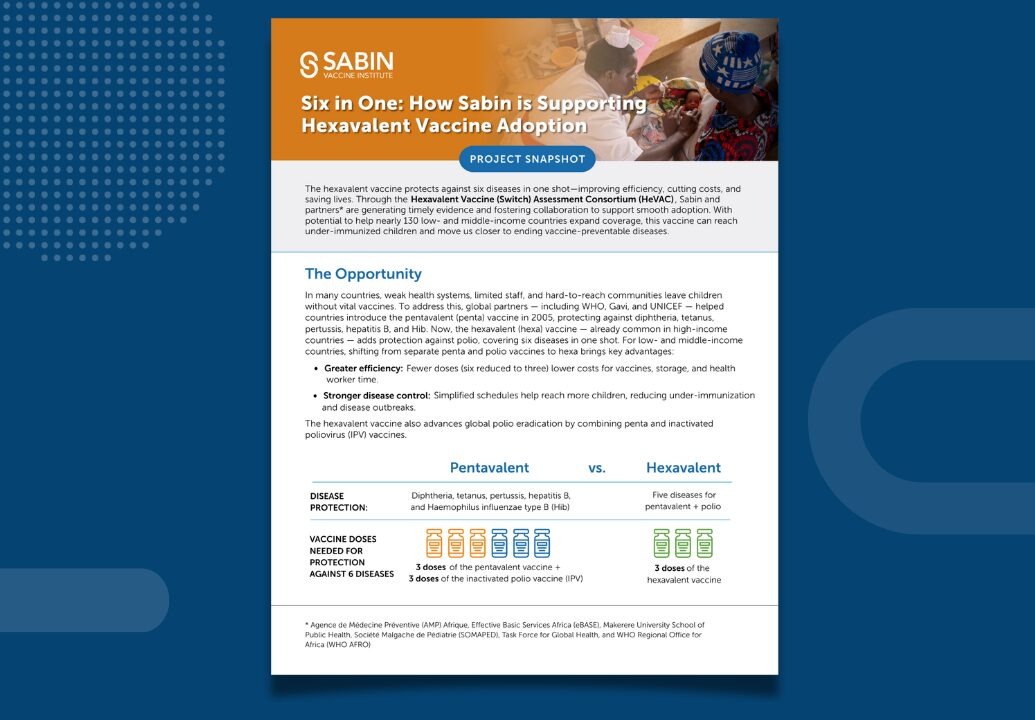

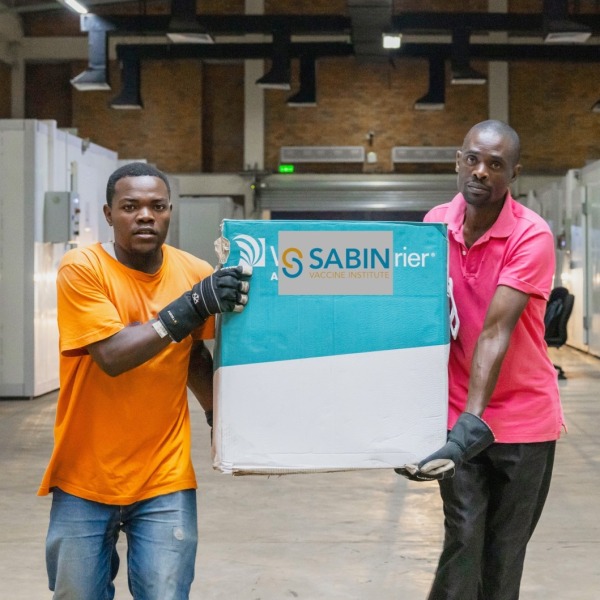
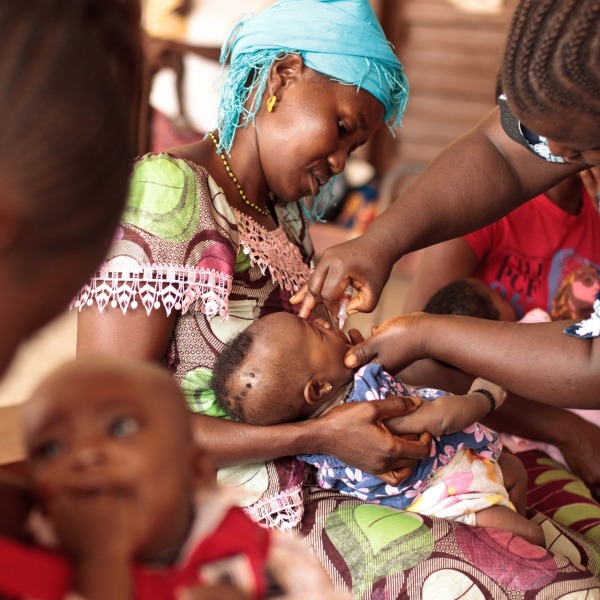




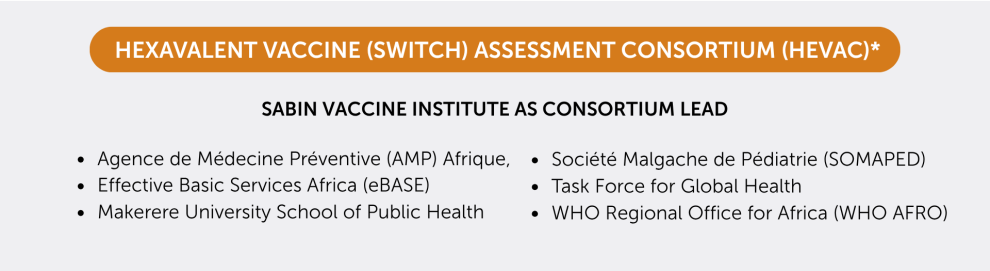
The hexavalent vaccine protects against six diseases in a one shot — improving efficiency, cutting costs, and saving lives. Through the Hexavalent Vaccine (Switch) Assessment Consortium (HeVAC), Sabin and partners* generated timely evidence and fostered collaboration to support smooth adoption. With potential to help nearly 130 low- and middle-income countries expand coverage, this vaccine can reach under-immunized children and move us closer to ending vaccine-preventable diseases.
See the journal articles that showcase results from Sabin’s work:
Optimizing decision-making, implementation, and monitoring to maximize the impact of the transition from pentavalent + IPV to hexavalent vaccine in Mauritania | Vaccine | December 2026
Accelerating Evidence-Informed Vaccine Introductions: Lessons from the Hexavalent Early Adopters Workshop | Vaccines | May 19, 2026
Innovative webinar-based training to support evidence-to-recommendation decision-making by national immunization technical advisory groups: multi-country experience with hexavalent vaccines | Vaccine | August 13, 2026
The Opportunity
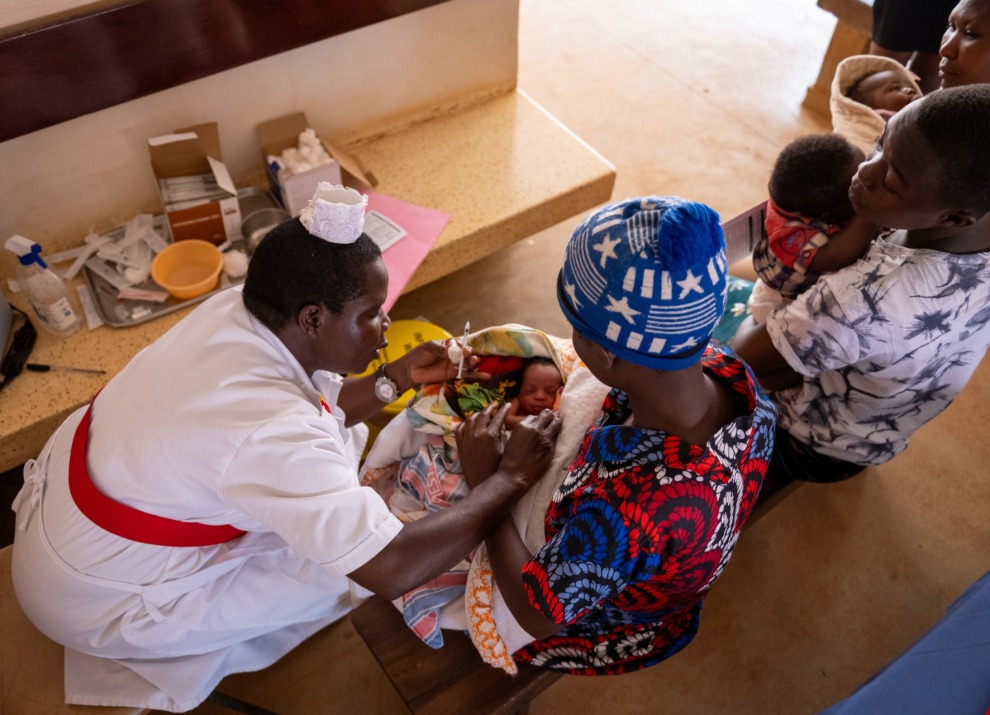
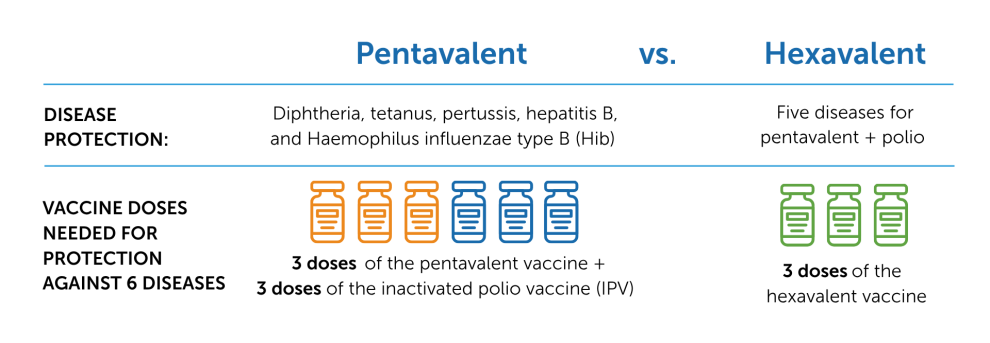
In many countries, weak health systems, limited staff, and hard-to-reach communities leave children without vital vaccines. To address this, global partners — including WHO, Gavi, and UNICEF — helped countries introduce the pentavalent (penta) vaccine in 2005, protecting against diphtheria, tetanus, pertussis, hepatitis B, and Haemophilus influenzae type B (Hib). Now, the hexavalent (hexa) vaccine — already common in high-income countries—adds protection against polio, covering six diseases in one shot. For low- and middle-income countries, shifting from separate penta and polio vaccines to hexa brings key advantages:
- Greater efficiency: Fewer doses (six reduced to three) lower the costs for vaccines, storage, and health worker time.
- Stronger disease control: Simplified schedules help reach more children, reducing under-immunization and disease outbreaks.
The hexavalent vaccine also advances global polio eradication by combining penta and inactivated poliovirus (IPV) vaccines.
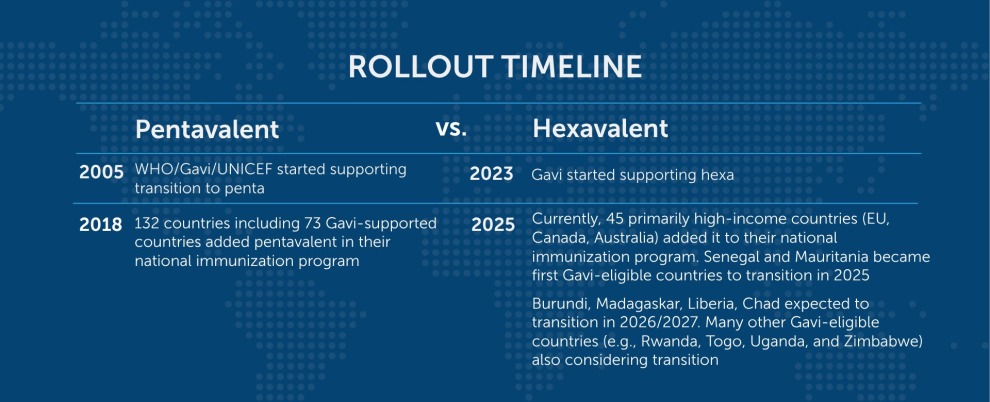
The figure presents this rollout timeline. Pentavalent vaccines: in 2005, WHO, Gavi and UNICEF started supporting transition to penta; by 2018, 132 countries, including 73 Gavi-supported countries, had added pentavalent vaccine to their national immunization programs. Hexavalent vaccines: Gavi started supporting hexa in 2023. The 2025 entry states that 45 primarily high-income countries, including countries in the European Union, Canada and Australia, had added hexa to their national immunization programs. Senegal and Mauritania became the first Gavi-eligible countries to transition in 2025. The figure projects transitions for Burundi, Madagascar, Liberia and Chad in 2026 or 2027, and lists Rwanda, Togo, Uganda and Zimbabwe among other Gavi-eligible countries considering transition.
Sabin’s Work
The Sabin Vaccine Institute, in partnership with Gavi and other partners*, has established the Hexavalent Vaccine (Switch) Assessment Consortium (HeVAC) to support countries transitioning to the hexavalent vaccine. The consortium focuses on two core areas:
- Collecting real-time implementation data
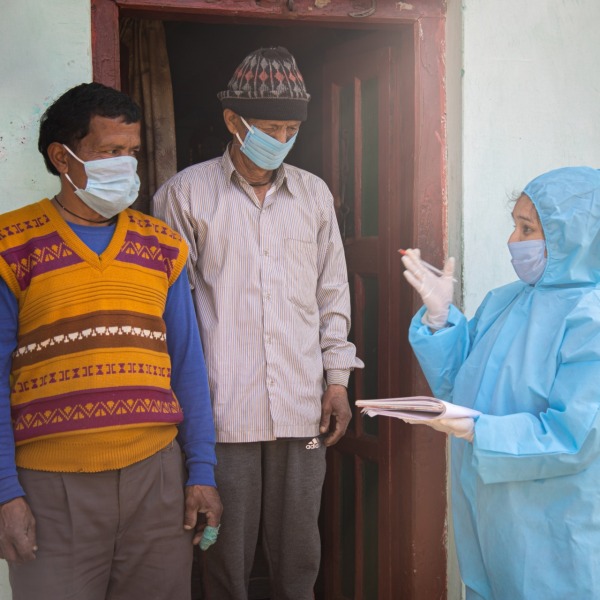
HeVAC conducted in-depth evaluations in Mauritania (which introduced hexavalent vaccine in July 2025) and in Madagascar (January 2026). These studies identify challenges, tracking impacts on coverage, and gathering real-world cost data. Results (see journal links above) provide valuable insights for other countries planning their own switch.
- Facilitating cross-country learning
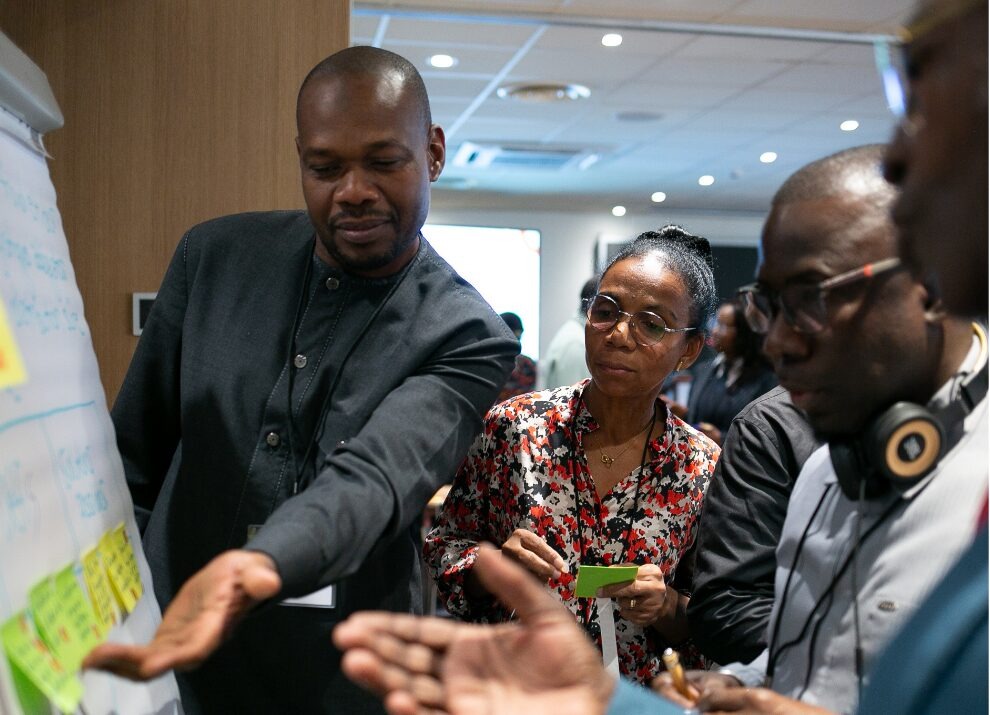
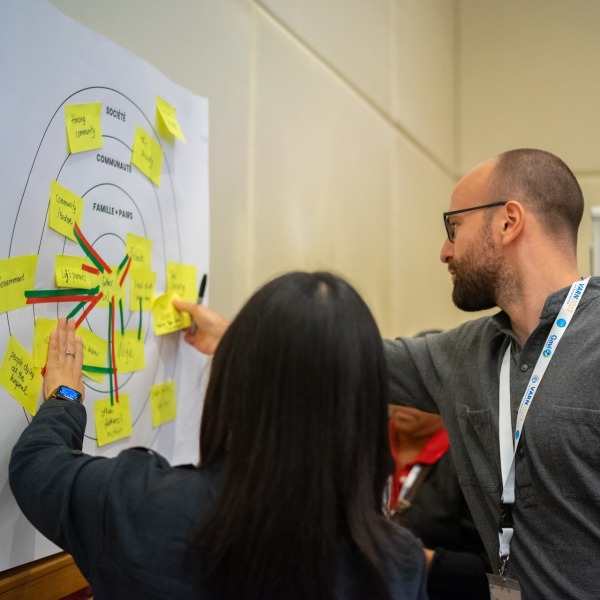
Sabin brought together health leaders from 32 countries — mainly in the WHO African Region — through virtual peer sessions and an in-person Hexavalent Early Adopters Workshop in Senegal with leaders from 10 African nations. This regional platform connects ministries of health, National Immunization Technical Advisory Groups (NITAGs), and Expanded Programs on Immunization (EPIs) to promote peer learning and lasting collaboration. While the current focus is on 54 Gavi-supported countries, the initiative is also highly relevant for nearly 80 middle-income countries.
Through HeVAC, Sabin advances evidence-based rollouts, regional peer learning, and insights to guide Gavi’s policies and immunization innovation. As convener, Sabin leverages its global experience in partnerships and implementation research to lead this collaborative effort.
Why This Matters
We are delivering the knowledge and sharing the evidence countries need to confidently introduce hexavalent vaccines — a single shot that protects children against six deadly diseases. By reaching under-immunized communities, this transition not only saves lives but it also eases pressure on health systems, streamlines immunization, and helps countries build immunization programs that are more equitable and efficient.
Get Involved
Subscribe to our quarterly newsletter, Sabin Vaccine Wire, for regular updates.
To explore partnership opportunities, contact us at [email protected].